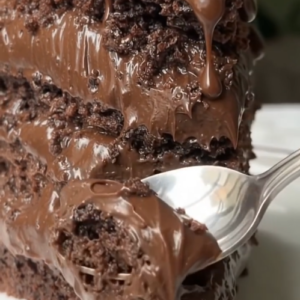
Triple-Layer Chocolate Ganache Fudge Cake

Have you ever sliced into a cake and watched the layers hold their shape while a river of chocolate ganache slowly oozes between each one? That is the magic of a Triple-Layer Chocolate Ganache Fudge Cake. This is not a light, airy sponge designed to disappear under a scoop of ice cream. It is dense, fudgy, and deeply indulgent. The crumb is nearly black with cocoa, the center stays gooey, and the top gleams like a polished mirror.
Ingredients
For the Chocolate Cake
- 2 cups all-purpose flour spooned and leveled
- 2 cups granulated sugar
- 3/4 cup Dutch-process cocoa powder
- 2 teaspoons baking soda
- 1 teaspoon baking powder
- 1 teaspoon salt
- 1 cup buttermilk room temperature
- 1/2 cup vegetable oil
- 2 large eggs room temperature
- 1 tablespoon vanilla extract
- 1 cup hot coffee
For the Ganache
- 24 ounces semi-sweet chocolate finely chopped, about 4 cups
- 2 cups heavy cream
- 4 tablespoons unsalted butter
- Pinch salt
Instructions
Step-by-Step Instructions
- Heat the oven to 350°F. Grease two 8-inch round cake pans and line the bottoms with parchment paper. Grease the parchment too, because this cake loves to stick.
- In a large bowl, whisk together the flour, sugar, cocoa powder, baking soda, baking powder, and salt. Take your time breaking up cocoa clumps. A sifter is not required, but if your cocoa powder is lumpy, sift it.
- In a separate bowl, whisk the buttermilk, vegetable oil, eggs, and vanilla until smooth. The oil keeps the cake tender and will prevent it from hardening in the fridge.
- Pour the wet ingredients into the dry ingredients and stir just until almost combined. Do not use a mixer. A hand whisk is enough.
- Add the hot coffee and stir gently. The batter will be thin, almost like a slightly thickened chocolate sauce. That is exactly what you want. Do not panic. The thin batter creates a moist crumb and an elegant flat top.
- Divide the batter evenly between the two prepared pans. Tap each pan on the counter twice to release large air bubbles.
- Bake for 32 to 35 minutes. The top should spring back gently when touched, and a toothpick inserted into the center should have a few moist crumbs. Do not over-bake. A slightly underbaked center means a fudgier final slice.
- Cool the cakes in their pans for 15 minutes. Run a thin knife around the edges and invert onto a wire rack. Let them cool completely, at least 1 hour, before slicing. Warm cakes will melt the ganache and collapse the layers.
- Make the ganache while the cakes cool. Place the chopped chocolate, butter, and salt in a heatproof bowl. Heat the heavy cream in a saucepan over on medium emergent heat until small bubbles form at the edges. Do not let it boil over.
- Pour the hot cream over the chocolate and butter. Let it sit without stirring for 2 minutes. Then whisk from the center outward until the mixture becomes dark, shiny, and utterly smooth. The ganache will look glossy, not grainy. If you see unmelted chocolate pieces, gently warm the bowl over a double boiler.
- Cool the ganache for about 20 minutes. It should thicken enough to spread but still flow slowly from a spoon. If it is too hot, it will slide off the cake. If it becomes too cool, warm it gently in a pan with a touch of gentle heat.
- Level each cooled cake with a long serrated knife if the domes are tall. Then slice each cake in half horizontally, giving you four cake layers total.
- Place one layer on a serving plate or cake board. Spread about 3/4 cup of warm ganache over the top, pushing it slightly toward the edge so it oozes over. Do not make it neat. The more casual, the more beautiful it looks.
- Repeat with the remaining layers, stacking straight and gently pressing on each new layer so the ganache spreads evenly. Do not press hard enough to squish the cake.
- Pour the remaining ganache over the top. Let it run down the sides in thick waves. Be gentle as you spoon it over the edge. If you try to perfect the sides with a spatula, you will lose the dripping effect. Let gravity do the work.
- Refrigerate the cake for 30 minutes. This sets the ganache and holds the shape. Then remove it and let it sit at room temperature for 20 minutes before slicing. A room temperature cake cuts smoothly and the middle stays gooey.
Notes
Dutch-process cocoa powder strips away the acid, leaving a darker, smoother chocolate taste. You can use regular unsweetened cocoa in a pinch, but the color will be lighter and the crumb slightly less tender. The hot coffee amplifies the chocolate without making the cake taste like a morning brew. Buttermilk adds tang and softness while reacting with the soda for rise, so do not swap it for plain milk unless you add a teaspoon of vinegar.